Homage to Minneapolis
George Orwell, myself, and parallels across time and space.

Last week I read George Orwell's Homage to Catalonia, which is his account of a period of six months in which he served in the Spanish civil war. Although he is more famously known for his novels, I found this work to capture quite a thrilling story from the real events he observed during the conflict. In a breezy 200 pages, we are brought along for scenes of a foreigner arriving to a Barcelona still humming with revolutionary promise, enduring a dull and harsh winter at the front, coming within millimeters of utter destruction, and barely fleeing the country as the political landscape quickly shifts around him.
I admire Orwell's ability of storytelling; mostly Homage moves along like one is listening to a wise relative or a friend recounting tales at the fireside. He carries a sort of candid tone, with a subdued sense of humor and a keen eye for the emotion present in the details. First arriving in Barcelona in December of 1936, Orwell describes a city in which working people have taken command. There is no class distinction between comrades, even referential forms of speech are substituted for egalitarian terms. Although the city appears a bit rough around the edges, Orwell can still perceive the post-revolutionary glow underlying it all:
All this was queer and moving. There was much in it that I did not understand, in some ways I did not even like it, but I recognized it immediately as a state of affairs worth fighting for (4).
Following a brief spell getting oriented in a militia manned by el Partido Obrero de Unificación Marxista (POUM), George is sent to the front. It is at this stage where the writer and reader both begin to understand the boring, and perhaps disappointing, realities of the war effort. Facing shortages in equipment, training, and the cold winter weather, misery abounds in these chapters. Much anxiety and stress comes to the fore, only to dissipate with no satisfactory payoff. Orwell paints an honest picture of 20th-century trench warfare, which mostly consists of sitting and staring at one's opponent from across the valley.
Despite spending months on the front lines, the most action that our narrator sees is actually on his leave back in Barcelona, where he witnesses a week or so of street fighting in May of 1937. More than this, much of the drama of Homage comes from Orwell's perception of these events and how it differs with the story told by the press, both locally and internationally. A conflict which by his account appears to be a simple one between Anarchists and workers against a suppressive police force is, by outsiders in the intelligentsia, deemed to be a Fascist plot meant to sow discord within the Popular Front.
Something I find fascinating is that amongst all the noise and finger-pointing during this time, Orwell is able to cut through most of it and present a very human account of events. Mostly, his narration is concerned with traversing the city, seeking shelter and food, caring for friends he has made in Barcelona, and observing the humanity in the 'opposition.' He mentions the precedence of physical sensation over the sense that one is making history:
Throughout the fighting I never made the correct 'analysis' of the situation that was so glibly made by journalists hundreds of miles away. What I was chiefly thinking about was not the rights and wrongs of this miserable internecine scrap, but simply the discomfort and boredom of sitting day and night on that intolerable roof, and the hunger which was growing worse and worse (126-127).
I think ultimately details like these are valuable insofar as they remind us that, generally speaking, people are not terribly concerned with the large-scale dynamics and systems which define our lives, at least in the moment of action.
The final act of the book involves Orwell and his wife attempting to flee the country as the tide of the war continues to shift. Most of the revolutionary energy in Barcelona has waned, and in its place is a tense and precarious air. The POUM has been outlawed, and Anarchists are being tracked down and jailed without charges, including comrades and friends we have come to know along the way. Constantly having to look over his shoulder, Orwell describes the scenes thusly:
It is not easy to convey the nightmare atmosphere of that time – the peculiar uneasiness produced by rumours that were always changing, by censored newspapers and the constant presence of armed men (158).
At the time of writing, the Spanish civil war was still in progress. Over the course of the next two years, Franco's troops (with help from Germany and Italy) would eventually seize control of more territory, finally capturing Barcelona in January of 1939. The war ended, and the Fascists ruled for nearly 40 years afterwards.
Overall, I deeply appreciated and enjoyed Homage to Catalonia. It is compelling to read a text which is so deeply linked to grand historical events, and yet in its prose is concerned primarily with the humblest details of the experience. I suppose on some level, this is all that one can achieve with such a project. After all, we never truly understand the full extent of the forces at play in the world, even less so as we are subject to them in the present. Orwell's decision to document his journey through this complex of political and social upheaval is an honorable one, and I believe it sheds light upon the universality of the human experience.
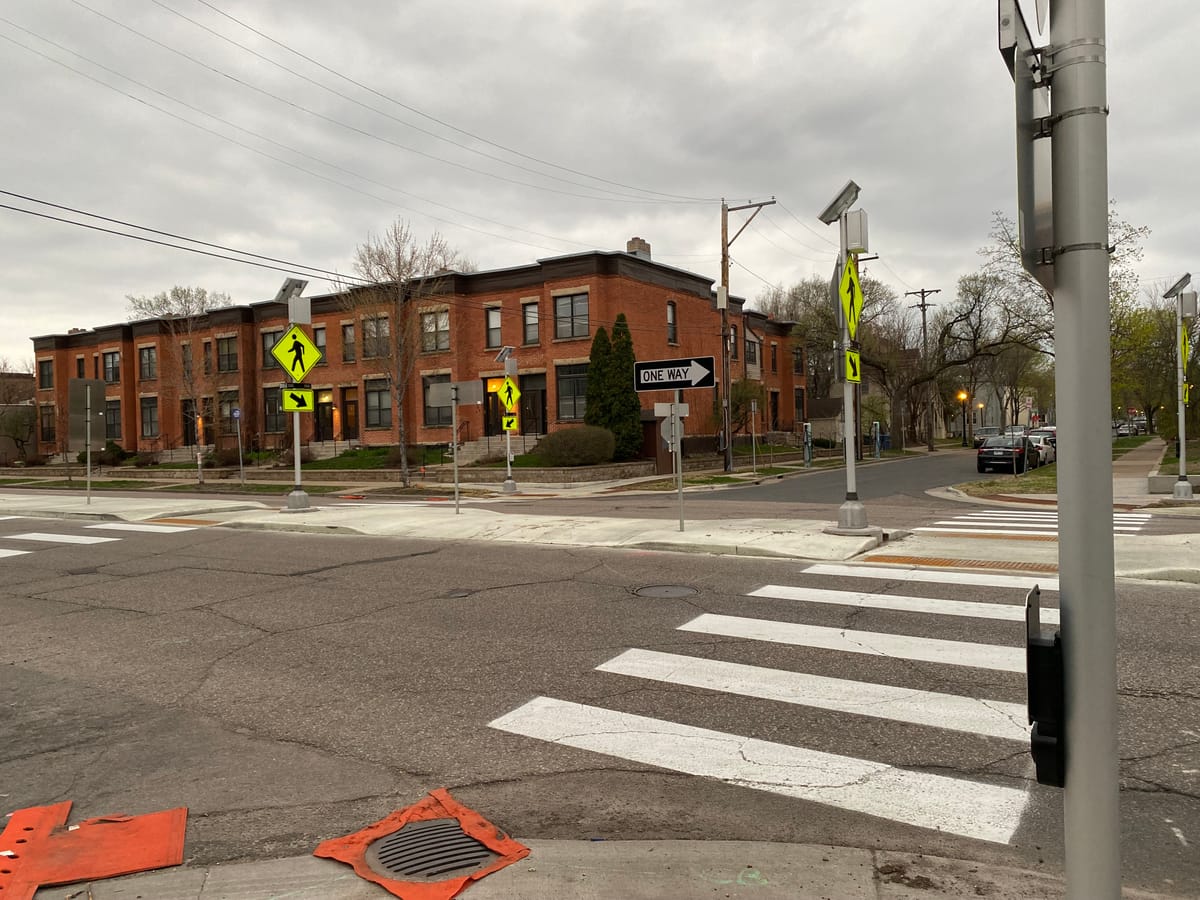
While reflecting on this book, I have been unable to avoid drawing parallels between the struggle against fascism in Spain and the struggle against the fascist regime currently vying for power in my home country. More than that, I find parallels between Orwell's personal account of Barcelona in a tumultuous time and my own experience in the city of Minneapolis, which has been the latest focal point in the DHS terror campaign against immigrant communities.
My dad grew up in Twin Cities suburbs, and much of his family is still located in the area. Growing up, I gained an impression of the Twin Cities mostly via sporting events (the Metrodome was so sick), and later moved to Saint Paul for college. My first memories of Minneapolis as an adult came inside an ESL classroom where I was volunteering with a handful of peers. The students in my beginner-level class were almost exclusively Somali women. I remember with time coming to learn their different personalities: Asha was inquisitive and eager to ask questions, Fatima always wore a smile, Fardowsa definitely knew enough to graduate to the next level but wanted to stay and help her friends. I remember they would bring tea and share with us during break time. Now that I have moved to Spain, I find myself yet again in the English classroom. Funny how life rhymes.
I moved out of Saint Paul just two days before George Floyd was murdered in 2020. I recall being glued to twitter updates from friends that were still in town and on the streets. I had seen videos of police escalation and brutality against protestors. I became acutely aware of mayor Frey's kowtowing to MPD, and of my own absence from the scene. After spending a year in Chicago, I returned - this time to Minneapolis - with two amazing generous friends. I came to know the "city of water" in a new way: walking the dog around various neighborhoods, becoming a regular at cafes, taking the bus to commute to work. In the next year I would meet lots of kind people and make plenty of warm memories that I carry with me.
My dear friend Liam still lives there, working in community organizing. Naturally he has spent the last few weeks completely exhausted, putting in 14-hour days to facilitate observer training, political education and direct action efforts. He told me that last Friday's general strike was "like nothing he'd ever seen," and also that the next morning was so incredibly horrible following the execution of Alex Pretti. Lately, Minneapolis has been a theater for some of the best and worst that humans are capable of; the terror and wanton violence of the state sits in contrast to the resolve and beauty in the resistance from normal people defending their neighbors' right to a dignified life (in the midst of a polar vortex, no less). I have been continually impressed and humbled by the selflessness of the people of this city. Time and time again, Minneapolis stands as an example against the myriad social pressures that try to convince us that sticking your neck out for someone else will never pay off.
In its operations all over the United States, we have seen ICE harass and detain observers and passersby on trumped-up or completely fabricated charges of 'obstruction' or similar. I hear echoes of this behavior in Homage to Catalonia during the hunt for POUM members in Barcelona, which strikes at the heart of the issue:
It did not matter what I had done or not done. This was not a round-up of criminals, it was merely a reign of terror . . . Practically the law was what the police chose to make it (173).
The issue with ICE, or 'law' enforcement more generally, is not that they don't have enough training or administrative checks to keep them in place (this is what Democrats are always getting wrong, to the point of complicity). The issue with DHS is not that the wrong kind of person is in charge (see Tim Walz' recent comments on Tom Homan). The issue is that the organization of DHS itself is a fascist one, designed (yes, designed, as in 'on purpose') to terrorize our neighbors and communities. The issue is that with financial support and legitimization from BOTH sides of the aisle, they act recklessly and with impunity; they may bully anyone and everyone to get their way. This department serves as a microcosm of the regime at large.
Much of the narrative of the last few weeks in Minneapolis has been crafted and conveyed by people with little to no skin in the game. Lies of paid protestors and other DHS propaganda, while fairly transparent in their falsehood, are indeed manipulating the conversation in the public eye. In this moment I cannot say what the 'official' story will be after the dust settles; I cannot determine what lessons are taken forward from these events. I can, however, share this wisdom from Orwell on the inherent limits of reporting events:
I believe that on such an issue as this no one is or can be completely truthful. It is difficult to be certain about anything except what you have seen with your own eyes (195).
Although I am no longer in Minneapolis, I have experienced the city and its people enough to bring clarity to my vision. My eyes have seen people go out of their way to protect strangers not because they have the perfect idea of political action, but because they know it's the right thing to do. My eyes have seen George Floyd Square, and met the eyes of those who have fought to honor his memory and demand a safer future. My eyes have seen a Minneapolis that is multiracial, queer, caring, committed, and exemplary of the heights that humans can achieve in the practice of humanity.
At the time of publishing, DHS seems to be attempting to change the narrative of their actions and motives to save face. This does not change the reality on the ground for the city of Minneapolis; shakeups among top staff does not mean the battle is won or that we are close to the end. Observer patrols will continue, mutual aid networks will provide food and support to those who cannot travel. The work is still ongoing, and it requires us to continue to show up for each other, in whatever way we can. Solidarity and warmth to the people.